Jaguar’s controversial rebirth as an all-electric carmaker shifted into gear today as it finally revealed what it claims to be ‘one of the most eagerly awaited cars in recent history’.
In a shock rebrand for the 91-year-old British manufacturer, it stopped selling all petrol and diesel cars in December last year.
The overhaul sparked a fierce backlash from critics including Donald Trump for its unconventional and ‘woke’ campaign, which featured androgynous models in avant-garde, brightly coloured clothing without showing a single car.
Now the new Type 01, unveiled yesterday in a glitzy New York takeover, will ‘reposition’ Jaguar in the market to secure its future by selling fewer cars in a higher price bracket.
The car will cost around twice as much on average as its previous combustion-engined models, starting at around £120,000.
It boasts 23in wheels, more than 1,000 horsepower and a real-world range of 400 miles.
The monumental, 5.2m-long four-door grand tourer, which hits 62mph from a standing start in just 3.2 seconds, will ‘never arrive unnoticed,’ Jaguar says.
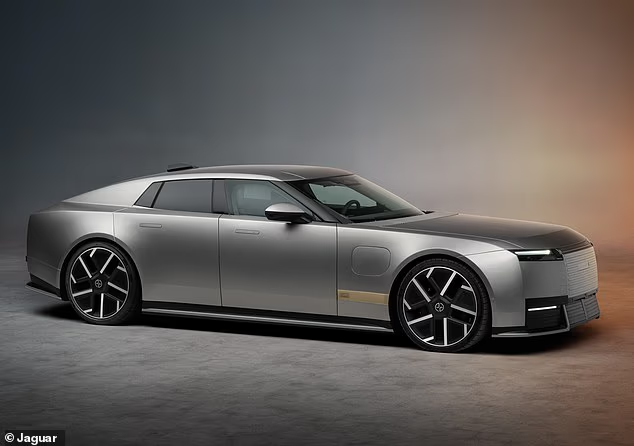
Jaguar’s daring electric rebirth: The British brand has unveiled its new Type 01 four-door GT car that will arrive with customers from next year
The launch comes almost two years after Jaguar announced its dramatic rebrand in November 2024 with an advertising campaign featuring distinctive fashion models and bold slogans such as ‘Copy Nothing’, ‘Delete Ordinary’, ‘Break Moulds’ and ‘Live Vivid’, but no cars.
It also confirmed it would retire its iconic ‘growler’ badge of a Jaguar baring its teeth in favour of a more contemporary visual identity.
A fortnight later, Jaguar stoked the embers of the uproar with the reveal of the Type 00 – an electric concept signalling the direction of its future zero-emission cars painted in a shade of Barbie satin pink.
The move prompted unprecedented criticism from existing customers, the wider public and high-profile figures including Elon Musk and Reform UK leader Nigel Farage.
US President Trump dubbed the whole rebrand ‘seriously woke’ and a ‘total disaster’ that had left Jaguar in ‘absolute turmoil’.
But as the covers eventually came off in New York last night, managing director Rawdon Glover told the Daily Mail he was confident the Type 01 was ‘going to appeal to a target audience’ of younger urban buyers who ‘want to make a strong statement about themselves’.
But he acknowledged that the car’s expansive proportions and polarising design will not be to everyone’s taste.
He said: ‘I am worldly enough to know that for some people it’s perhaps too bold. And that’s OK.’
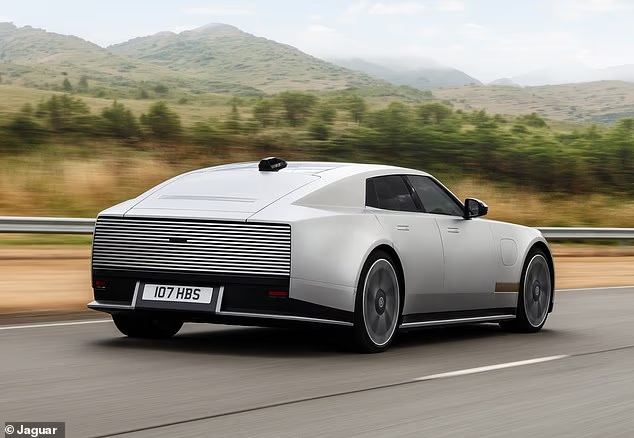
The striking electric saloon is expected to start from £120,000 with higher spec models exceeding £150,000
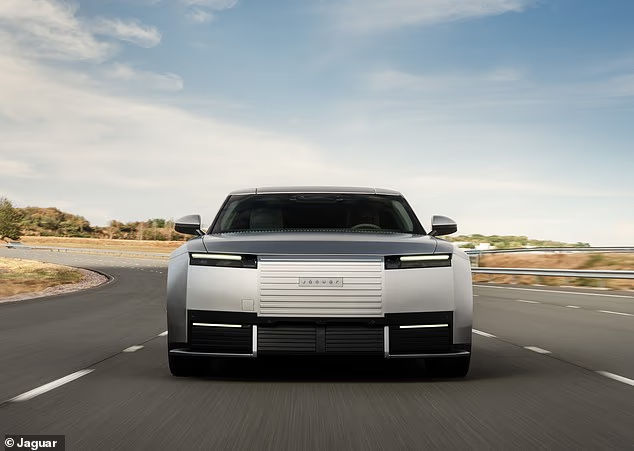
Bosses say its aim is to ‘reposition’ Jaguar in the market in a bid to secure the future of the 90-year-old British manufacturer by selling fewer cars at a higher price point
The company previously stated it expects 85 per cent of customers buying its next generation of EVs to be new to the brand as the carmaker veers in an entirely different direction in terms of powertrain, styling and price.
But its managing director says some 50,000 people have already expressed an interest in being ‘kept informed’ about Type 01’s availability, with 78 per cent non-Jaguar owners, suggesting a slightly higher retention rate than originally predicted.
‘Jaguar was absolutely at a crossroads. We realised we needed to make some really big decisions about where we went next with the brand,’ Glover said.
‘Our client base was shrinking and ageing. That’s not a great combination. And if you look at the commercial performance of the Jaguar brand, all those things pointed us in one direction.
‘We had to do something much bolder and take a very big step forward.’
The Type 01 is the most aerodynamic Jaguar ever and is just 4ft 6in high, with battery-cooling vanes at the front and a spoiler at the rear.
It is also the structurally stiffest and most powerful road car the company has produced.
A tri-motor setup, with two electric motors at the rear and one at the front, produces 1,015 horsepower and 1,035 Newton metres of torque, with drive sent to all four wheels.
Even more impressive than its 0 to 60mph time is its acceleration from 62 to 112mph, which takes just four seconds – the result of Jaguar’s focus on reviving a tradition of delivering cars with ‘power in reserve’.
At its heart is a 118kWh battery that delivers up to 450 miles of range under the official WLTP test cycle used to ratify all new models entering showrooms.
But Jaguar says its own tests show the Type 01 will cover 400 miles in real-world conditions and as much as 320 miles when driven continuously at motorway speeds.
Its 850-volt charging set-up also gives it the ability to add 200 miles of range in just 13 minutes.
Customers will be able to place orders from early 2027, with first deliveries expected after the middle of the year. Glover says it will not be the best-selling model in Jaguar’s forthcoming line-up, but it will be the most striking.
It will be built in Solihull, and although annual production output has not been disclosed, the volume will be a fraction of the petrol Jaguars produced in recent years.
It will undoubtedly be joined by a Type 02 and possibly a Type 03 model in the coming years, one of which is almost certain to be an SUV.
Jaguar Type 01 specs at a glance
Price: From between £120k-£140k
First UK deliveries: Mid-2027
DIMENSIONS
Length: 17ft
Width: 6ft 7in
Height: 4ft 7in
Weight: 2,700kg (est)
Wheels: 23in (21 in optional)
Boot space: 16 cubic feet
PERFORMANCE
Electric architecture: 850V
Battery: 120kWh battery (118kWh usable)
Electric motors: 3 (2 rear, 1 front)
Transmission: Single-speed auto
Drive: Four-wheel drive
Max power: 1,015hp
Torque: 1,035Nm
Acceleration (0-62mph): 3.2 seconds
Acceleration (62-112mph): 4 seconds
Top speed: 155mph
Turning circle: 37ft 9in
RANGE & CHARGING
Official range: 450 miles
Real-world range: 400 miles
Charging capacity: up to 350kW
Charging speed: 10 per cent to 80 per cent in 22 minutes (it can add 200 miles of range in 13 mins)
Jaguar Type 01: Design
The Daily Mail and This is Money were granted early access to the new Type 01 a few weeks before the New York reveal. In fact, it was the third time we’d seen the car without it being decked out in camouflage.
And, without question, it will be the sheer scale and polarising design of the electric four-door saloon that generates the most conversation and controversy.
Jaguar says the EV demanded ‘exuberant proportions’ to create a sense of ‘drama from every angle’.
This is amplified by the Type 01’s monolithic body, which features expansive panels with few shut lines to create a reductive, sculpturesque appearance.
The slab-fronted grille, elongated bonnet and visor-like frameless windows (the doors are frameless too) accentuate its vast size, as does the slimline four-light arrangement at the front. These are just 3.3in tall (the narrowest headlights ever on a Jag) that each contain 17,000 pixels and are shaped to make the car distinctive in your rear-view mirror, even from a distance at night.
The absence of a rear window only serves to further exaggerate its epic dimensions.
Yet it also looks planted on the road.
This is largely thanks to its colossal 23in wheels, fitted as standard, which account for more than half of the Type 01’s total height and give the impression of the car being hunkered down to the ground.
I can tell you there is some subtlety to the design that you’ll only begin to appreciate when you see the Jag in the metal.
There’s a curvature to the doors that photographs of the satin-painted car almost disguise, while the ‘Impossible Panel’ – the three-metre-long section of bodywork that meets at numerous angles to create an arrowhead-like indentation in the rear quarter panel – is nothing short of a work of art.
The redesigned Leaper logo’s strikethrough element is also carried across various sections of the car, not just the bronze-effect aluminium signatures behind the front wheel arches.
The batten-style hallmark is used for both the front grille and rear light cluster, with the brake lights and indicators concealed within the upper sections (a third brake light sits flush in the tailgate above the active spoiler).
These straight lines are mirrored from the top edge of the bonnet onto the upper section of the cockpit to create a sense of continuity.
And the motif is repeated on the door mirrors and the interior rear panel leading into the 450-litre boot compartment that’s a modern twist of the classic E-Type’s stowage area and has a hidden section under the floor.
With a drag coefficient of 0.23Cd, this is the most aerodynamic Jaguar ever.
Not only does it better the F-Type Coupé (0.34Cd), it’s not far short of the slipperiest production car on the market, the American electric Lucid Air, which has a Cd figure of 0.197.
Glover says Jaguar will retain some control over the specification and finish of the initial cars delivered to clients, with customers able to choose from a range of satin and gloss paint finishes.
Well-heeled buyers willing to wait a few months are likely to gain access to JLR’s bespoke personalisation programme, where they can add individual touches and create unique paint finishes, all at a premium, of course.
My opinion on the looks
Jaguar has been incredibly open about the fact that this car isn’t going to be to everyone’s taste.
In fact, I get the distinct impression it’s expecting plenty of criticism, especially after the furore surrounding its controversial rebrand announcement two years ago and accusations that it had turned its back on almost a century of heritage.
However, Jaguar’s top brass remain steadfast in their belief that the Type 01 and the company’s wider strategy represent far more than a change in powertrain. This is a complete transformation of the brand’s identity.
It no longer wants to be a mainstream player. Instead, it’s targeting a smaller share of the highly lucrative luxury market.
And with more eyes on Jaguar than ever before, you have to wonder whether there’s really any such thing as bad publicity for this new era of electric Jags.
Do I personally like the way it looks? In parts, yes. But certainly not in its entirety.
But the question I’ve been asking myself for months is whether I’m Jaguar’s target audience going forward.
Young? Not any more. Urban? Nope. Affluent? I wish. Obsessed with technology? Absolutely not.
So this isn’t a car aimed at me at all.
And that’s precisely why Jaguar couldn’t give two hoots about what I, or anyone else like me, thinks.
Will it be enough to save Jaguar? Only time – and the availability of more models in the line up – will tell.
Jaguar Type 01: Battery and charging
The total capacity of Type 01’s lithium-ion battery is 120kWh, though just 118kWh is usable. And its safety is monitored constantly.
While the car will be officially certified with a 450-mile range, Jaguar’s own tests suggest 400 miles is the achievable distance between charges.
That should be enough for its usual client base; its analysis of 920,000 JLR vehicles found that 99.7 per cent of its cars never cover more than 303 miles in one driving stint. Though this isn’t a car aimed at its existing clientele.
There’s plenty of smart tech to bolster the performance of the battery.
The brand’s advanced battery management software continuously checks the health of every cell. If it detects an overheating issue, Jaguar says it can isolate an individual cell in as little as five milliseconds.
As a result, the Type 01’s battery is covered by an eight-year or 100,000-mile warranty.
It also features JLR’s ThermAssist technology, which is also being rolled out across the Range Rover Electric and Range Rover Sport Electric.
This system automatically directs available thermal energy to where it is needed most for maximum efficiency, whether that’s the battery to accelerate charging speeds or the cabin to provide warmth on a winter morning. By transferring heat in this way, the battery cells can be maintained at their optimum operating temperature, helping to extend battery life.
While the Type 01’s 850-volt architecture enables charging speeds of up to 350kW, Jaguar says ultra-rapid chargers capable of delivering that output are not yet widely available in most countries, including the UK.
To address this, the battery features split-charging capability to charge in two separate sections, allowing up to 250kW from a suitable 400-volt charger.
One clever touch is the inclusion of charging ports on both front wings of the Type 01.
Both support AC charging at up to 22kW, meaning drivers don’t need to worry about which side the charging socket is on when pulling up to a public charger at the roadside or a friend’s home wallbox. The right-hand port also supports DC charging.
Source : dailymail.com