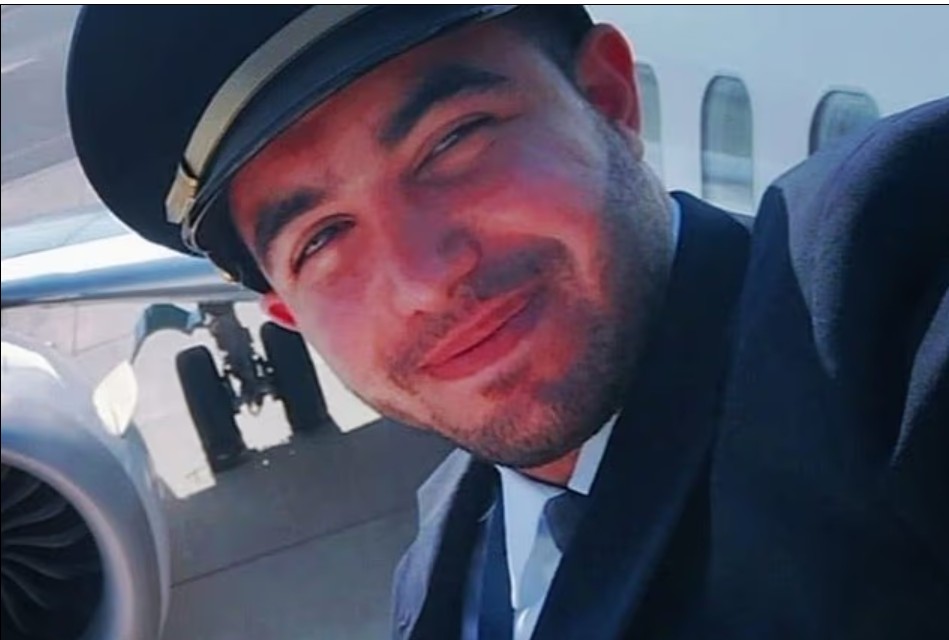
The co-pilot who attempted to hijack an Israel-bound flight had previously been banned from flying over concerns he had adopted extremist views as it’s revealed he spent time in ISIS-controlled Syria.
Omani national Hamam Al Hammami, 29, severely wounded captain Smit Machchhar using the onboard crash axe as he attempted to take control of the Flydubai plane, which was heading towards Tel Aviv on Wednesday morning.
Passengers and crew grappled with the co-pilot to regain control of the plane, which had plummeted 14,000ft in just 29 seconds. It is believed a British off-duty pilot was among the saviours.
The co-pilot had previously worked with Oman’s national airline as a trainee in 2024 but was removed from flying because of concerns that he may have been influenced by radical groups from time spent in Syria, according to officials. He was then moved to an administrative job at Oman Air.
Al Hammami was later hired by UAE-based airline Flydubai, but it was not immediately clear to what extent the co-pilot was vetted.
However, it has been confirmed by a Gulf diplomat that he had undergone standard security checks before being hired, but it appears the checks focused on whether he had been convicted on criminal charges and didn’t go deeper into examining his background for potential signs of radicalisation.
The United Arab Emirates, which is leading the investigation, is now working to establish if he acted as a ‘lone wolf or has any connection with any extremist groups’.
Al Hammami, who studied at a British university, was born in the UAE, and his mother is Syrian. He obtained Omani nationality from his father.
A source at the Buckinghamshire New University reportedly confirmed that Al Hammami completed a three-year distance-learning course and graduated with a degree in aviation management in 2023.
The source said that Al Hammami did not take any pilot training at the school. The Daily Mail has gone to the university for comment.
It is understood he also studied engineering at a university in Australia.
According to state news agency WAM, UAE Attorney General Hamad Saif Al Shamsi said ‘the co-pilot had attempted to carry out a terrorist act’ and had ‘attacked the captain in the cockpit with the emergency axe and tried to take control of the aircraft’.
On Friday, Israeli prime minister Benjamin Netanyahu said the suspect had undergone ‘Islamist radical indoctrination’.
Al Hammami, who was transferred Thursday from Saudi Arabia to the United Arab Emirates, is understood to be ‘co-operating’.
A Flydubai spokesman in an email said the airline could not comment beyond its official statements and acknowledged ‘there are many questions at this stage’.
Airlines are generally required to carry crash axes in the cockpit that could be used in an emergency to break open a window or break open a panel to access a fire.
The axes are generally stored in the cockpits where the crew can reach them, but they aren’t accessible to passengers.
Video footage at the time captured the terrifying screams and cries of passengers onboard Flight FZ1073 that plunged into an erratic descent.
The flight, carrying 182 people from Dubai to Tel Aviv, was diverted to Tabuk in north-western Saudi Arabia for an emergency landing.
It transmitted a general emergency signal using a squawk code – four-digit numbers used for in-flight communication – of 7700 while making a U-turn over the border between the two countries.
While flying over Saudi Arabia, it briefly issued a code of 7500, signalling unlawful interference or a hijacking.
Officials feared the incident could have become another ‘September 11’ attack, adding that passengers had prevented an ‘Israeli 9/11’ by tying up the assailant.
A person who heard the crew’s mayday call with air traffic control described the plane being turned away by Saudi Arabia and Jordan before eventually landing in the major city located in the north-west of the kingdom.
The person, who wishes to remain anonymous, said the pilot’s voice was trembling as he called ‘mayday’ and said a hijacking was taking place and ambulances would be needed.
But Saudi Arabia initially denied clearance to land and directed him to Jordan. The plane was told to wait for clearance from the Jordanian military and then turned away.
The pilot then returned to Saudi Arabia and said he had to land in Tabuk. The air traffic control operators gave no reason for the earlier refusals.
Israeli prime minister Benjamin Netanyahu said the attacker was arrested in Saudi Arabia on Wednesday afternoon and was undergoing interrogation there.
Passengers and crew, including the captain Mr Machchhar, have been hailed for their bravery in preventing what is believed to be an attempted suicide mission. One of whom is said to have been an off-duty British pilot.
Mr Machchhar was praised for saving the lives of those 174 passengers on board, which included four Americans. While cruising mid-air, the hero was able to fight off his co-pilot in the cockpit and his attempts to sabotage the plane’s systems.
Distressing footage showed Mr Machchhar lying on the ground covered in blood as passengers tended to his injuries, while another pilot is seen seemingly lying nearby unconscious. Passengers can be heard telling one of the men: ‘You saved the plane.’
Delhi’s embassy in Saudi Arabia has since confirmed Mr Machchhar is being treated in a hospital in Tabuk.
The incident was described as ‘an attempted jihadist terror attack’ by Israel’s defence minister Israel Katz, which was ‘thwarted only thanks to the heroism of several Israeli passengers’.
This includes one, named by local media as Yaniv Hayoun, who was called a ‘hero’ by Mr Netanyahu during a meeting as he arrived back in Tel Aviv.
Mr Hayoun, who was wearing a blood-soaked T-shirt, embraced the Israeli PM before describing how he broke down the cockpit door and wrestled with the co-pilot before taking over control of the plane – the skills of which he credits to his watching of TV show Air Disasters, which investigates notable aviation crises.
Speaking to the Daily Mail, Mr Hayoun recounted the terrifying moment he stepped in, describing how he put the pilot in a headlock and prevented him from interfering with the controls as the jet plunged towards the ground.
‘About an hour before landing, a woman started shouting,’ he said, ‘At the front of the aircraft, a woman started screaming something about stabbing: “He’s stabbing him, he’s stabbing him”.’
Mr Hayoun said he ran towards the cockpit, which is where the woman’s screams were coming from, but as he approached, the plane nosedived.
Photos from the incident show blood-covered passengers in the aftermath of the attack, after they successfully managed to overpower the knifeman and prevent him from continuing his assault.
‘It lasted several seconds. I don’t know exactly how many seconds it was, but they say we lost 14,000 or 15,000 feet in less than a minute — the aircraft lost that altitude. It was enormous.’
Speaking later, one passenger said the turbulence felt like ‘riding a rollercoaster’.
Another passenger, Zvika Manes, said people were ‘flying out of their seats’ before the plane stabilised.
When he managed to recover from the shock, Mr Hayoun said he got to the door of the cockpit, where someone was holding the handle.
‘I opened the door – I pushed the door while he was holding the handle. I pushed it open and went inside. On the floor, right beside the door, was the pilot. He was lying there. He was very seriously injured.’
‘There was no pilot in the pilot’s seat. One pilot was lying beside the door, seriously injured but conscious. His eyes were open. Between the two seats are the aircraft’s controls.’
Mr Hayoun recounted how the knifeman had his knees on the plane’s controls, ‘as though trying to interfere with the instruments’.
‘He was leaning forward toward the aircraft’s controls. So I grabbed him by the throat,’ he said, ‘I pushed him out toward the exit and started shouting for people to come and help because he was resisting.’
The hero explained that at least three other Israelis rushed to his aid.
‘We subdued him with blows. We had to stun him, so he took some blows. We tied him up.
‘Once he was no longer a threat, we simply stood over him and made sure he couldn’t free himself. He may even have lost consciousness for a few minutes – I don’t know.’
After the attacker had been subdued, Mr Hayoun quickly returned to the plane’s controls, in a desperate attempt to save the aircraft from plummeting to the ground.
‘I leaned over the seat, reached forward with my hands and pulled the controls toward me because the aircraft was pointing downward. I pulled the controls back toward me. It was only for a few seconds.’
Speaking to the Mail after safely returning to Israel, the grandfather explained how he miraculously knew what to do in the terrifying moments.
‘There’s a programme called Air Crash Investigation…The images are frightening and they make my wife afraid of flying, so I watch it secretly when she isn’t watching with me.
‘I saw on it that when an aircraft is going downward, you have to bring the controls back – pull them backward – to bring the nose level. It really was only for a few seconds. It wasn’t as though I flew the plane.’
He later recounted how his daughter used to ask him how the plane documentary would ‘ever be useful’.
‘Well, this is where it became useful to me,’ he said, ‘What I had seen became useful to me in the only attempt I’ve ever had in my life to survive. It was one shot – one opportunity.’
Despite his insistence he only helped for a’ few seconds’, Mr Hayoun’s heroic actions allowed time for one of the off-duty pilots on the plane to step in and take control.
United Airlines pilot and aviation safety expert Steve Arroyo said he was surprised that the plane was able to land safely after most of the rudder was ripped off the tail during the extreme descent.
‘That was a serious descent and strong aerodynamic forces on that rudder for that to happen. I’m just amazed the aircraft didn’t come apart,’ Mr Arroyo said.
Another aviation safety expert, Jeff Guzzetti, said that given the rate of descent, it may not have been possible for the plane to level out if it had fallen below 10,000ft.
‘It is remarkable they were able to pull out of that dive. What saved them is there was enough altitude left for them to recover,’ said Mr Guzzetti, who used to investigate crashes for the National Transportation Safety Board and the Federal Aviation Administration in the US.
Flydubai said in a statement it was suspending flights to and from Israel as it investigated Wednesday’s incident.
Source : dailymail.com