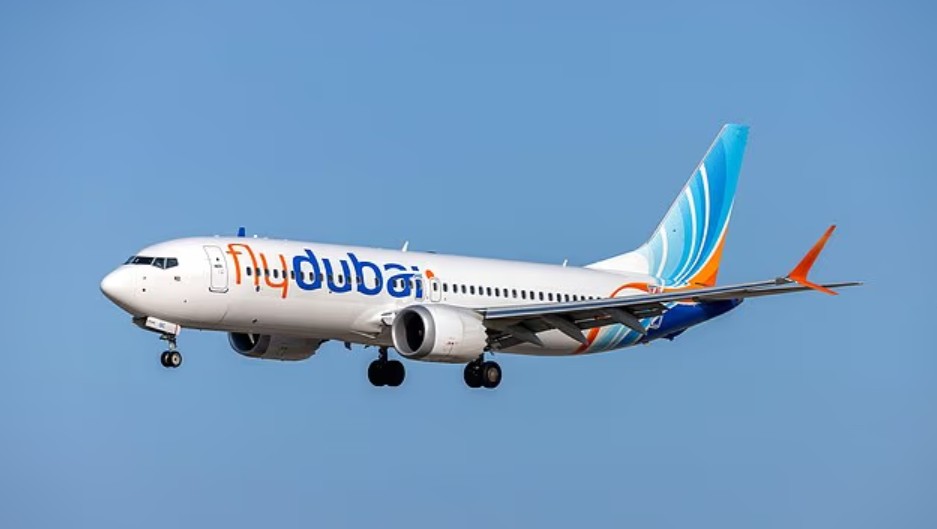
A commercial pilot flying from Dubai to Israel attacked his co-pilot before being overpowered by passengers in what is feared to have been an attempted hijacking.
Israeli passengers have said they believe the pilot was attempting to crash the Flydubai Flight FZ1073 from Dubai to Tel Aviv on Wednesday after allegedly stabbing his co-pilot.
A ‘major disaster was narrowly avoided’, an Israeli official told the Jerusalem Post, describing how travellers onboard the flight managed to subdue the pilot by tying him up.
The plane was diverted over Jordanian airspace towards Saudi Arabia, transmitting a general emergency signal and then another emergency signal of unlawful interference.
Israel closed its airspace and scrambled warplanes amid fears the jet had been hijacked, as Prime Minister Benjamin Netanyahu convened an emergency security meeting with Defence Minister Israel Katz.
Dramatic footage filmed by passengers moments after the alleged attack shows a crewmember covered in blood on the floor of the aircraft, outside the cockpit, as passengers tend to him.
A second crewmember is seen tied up next to him, seemingly unconscious.
Data from Flightrader24 shows a rapid descent for the jet over Saudi Arabia, just two hours after take-off, descending more than 17,000 feet (over 5,000m) in less than two minutes just after 05.21 UTC (06.21 BST).
Passengers on the plane told Israel’s Channel 12 that they heard shouts from passengers toward the front of the jet who heard the violent altercation between the pilots, and the aircraft dipped steeply before landing in Saudi Arabia.
The growing consensus among the Israeli security establishment, including the IDF, Mossad, and Shin Bet (Israel Security Agency), is that the incident was intended as an act of terror.
Photographs purportedly from the flight show one passenger with a white shirt, which is covered in blood.
Another recorded a video with blood over his face, emerging from a gash that stretches from his forehead down to his nose.
‘We’re here during the hijacking of an airplane. At this point we’ve subdued the terrorists, we’re approaching landing. Whoever is hearing me, we need help.
‘We’re landing in Tabuk, apparently in Saudi Arabia. An unknown, unfamiliar area. On the plane, everybody is safe and sound, other than the pilot. We need help,’ he said.
The plane initially transmitted squawk code 7700, indicating a general emergency, before switching to 7500, which signals unlawful interference, and later reverting to the initial code.
A regional official briefed on the incident said a fight broke out in the cockpit and apparently involved pilots, but added it wasn’t immediately clear what had caused the dispute.
Israel’s i24NEWS said it was currently being examined whether a stabbing incident occurred.
‘We were either going to crash or be murdered. It was like a terrorist attack in mid-air,’ one passenger told the outlet.
The channel reported that authorities are allegedly investigating whether the pilot attempted to crash the plane, which the co-pilot and passengers prevented.
Another passenger on the Boeing 737 MAX told Israel’s Channel 12: ‘We heard screams on the plane. Then they opened the cockpit and we saw blood, and someone had stabbed the pilot with a pocketknife.’
She described how the Israeli passengers helped restrain an attacker along with members of the crew. ‘We prayed, “Shema Yisrael,”‘ she said.
‘There were also moments when we thought we weren’t going to make it out alive.’
Another woman, identifying herself as Noam, told the network in a call: ‘Screams began on the plane… by passengers who realised what was happening.
‘We understand that one of the pilots was stabbed and seriously wounded, and they lost control of the plane. It started to dive quickly. It was very scary.’
One passenger, Itzhak Liber, recorded a video addressed to his family before uploading it onto Facebook.
‘We took control of the situation here on the flight,’ he said.
‘There was an attacker with a knife who stabbed one of the pilots.
‘We just jumped on him and restrained him together with the pilot.’
He said the attacker had been ‘neutralised’, was ‘seriously injured’ and had been ‘tied up’.
One passenger, speaking to Channel 12, said her husband helped to ‘neutralise the terrorist’.
The woman, Meital, says a member of the flight crew in the cockpit ‘tried to crash the plane’ and was subdued by passengers.
‘Someone shouted “stabbing” and my husband immediately understood what was happening and rushed to the front of the plane, and along with other Israelis they neutralised the terrorist,’ she said.
‘There were stabbings and a lot of blood,’ Meital added.
‘We’re very emotional and under terrible stress, it’s very difficult for me to talk.’
There was a second team of pilots in civilian clothes on the plane, according to the outlet, who allegedly prevented one of the pilots from taking over and crashing the jet.
A senior Israeli official told the channel that if the pilots had not been on the jet, the incident could have ended in another ‘September 11, 2001, attack or 1976 Entebbe hostage incident’.
The plane sent a the ‘squawk code’ of 7700, a general international emergency signal, as it made a U-turn over the Jordan-Saudi Arabia border.
When it flew over Saudi Arabia, it briefly issued a code 7500, meaning a hijacking or unlawful interference.
Data from publicly available sources shows that two hours and fifteen minutes into the flight, the jet suddenly took a sharp nosedive, dropping from 34,000 to around 17,000 feet in under a minute as it sped up from 411 knots to nearly 600.
The aircraft recovered slightly for several seconds, reaching 21,650 feet, before dropping sharply again, this time to under 14,000 feet.
Over the next hour, the plane failed to maintain a steady altitude, but it remained at around 15,000 feet, indicating it was being controlled by hand rather than autopilot, according to the Times of Israel.
Israeli authorities were unable to make contact with the jet during the incident.
A second official confirmed that Israel had scrambled warplanes, fearing a hijacking of a plane carrying dozens of its citizens.
Not long after the incident, the plane landed in Tabuk, a civilian and military base in the kingdom, with 180 passengers onboard.
Netanyahu has warned in recent days of unspecified, escalated security threats.
Both officials spoke on condition of anonymity because the incident was still under investigation.
Following the emergency landing of the plane in Saudi Arabia, the airline is sending a second plane to Tabruk Airport to fly passengers the remainder of the way to Israel.
Katz and IDF Chief of Staff Lt.-Gen. Eyal Zamir were also considering the possibility of dispatching Israeli military or civilian aircraft in order to bring the Israelis home, Walla learned.
Israel has not experienced a hijacking in decades but maintains some of the strictest airport security in the world.
Commercial flight have flown between Israel and the United Arab Emirates since the countries normalised ties in 2020.
A Flydubai spokesperson told the Daily Mail: ‘Flydubai can confirm that flight FZ 1073 operating from Dubai International (DXB) to Ben Gurion International Airport (TLV) on September 30 experienced an incident while en route.
‘The aircraft has landed safely in Tabuk Airport (TUU) and all passengers are safe and accounted for.
‘The safety and wellbeing of our passengers and crew remain our highest priority.
‘Our teams are working closely with the relevant authorities. Further updates will be issued as additional confirmed details become available.’
Source : dailymail.com